


Welcome to Favors Film Guides Online!
Favors Film Guides Online is the online and eBook version companions to Favors Film Guides, which represent case studies of select films.
Fair Use Disclaimer
This presentation falls under fair use. Source materials are appropriately attributed under copyright protection law.
Film Stills/Images
To prevent copyright and trademark infringement claims, this Favors Film Guides Online includes film stills and images available on the Internet and used here for teaching and instructional purposes.
Future print and eBooks may utilize images with copyright and trademark clearances.
This page includes both a downloadable document and follow-up, scene by scene discussion. The downloadable also houses the same content.
eBook Companion
Favors Film Guides Online: The Problem with Goal Development for Characters in The Town (2010)
This is an eBook that provides scene analysis and includes select film stills. This is the full version. The film stills and discussions follow on tis page.
Video Companion
There are video companions for the scene by scene discussion. It considers the film stills on this page, but the objective is to assess conflict within The Town (2010). You can find the video under The Town (2010) Case Study tab.
Scene by Scene Discussion
The scene by scene discussion focuses on the problem of goal development.
Film Summary
The Town (2010) falls under the American crime thriller genre as a drama. It is a heist film.

On the surface, The Town (2010) is a film about a group of individuals who conduct robberies in the city of Charlestown, Massachusetts, encounter issues with federal law enforcement, and reach an involuntary decision to get out of the “family business.” However, at the root is a friendship dynamic in which two men struggle with their perceptions of the “family business,” the town, and the purpose of family.
Doug MacRay and James (“Gem”) Coughlin are both protagonists and antagonists, respectively, who have different views about loyalty, betrayal, and the family business ideals that facilitate robbery.
One wants to give up the family business, but the other wants to maintain it. One is ready to leave town, and the other would rather stay. One lives in fantasy while the other lives in reality. It is Doug who completes his goal of leaving town, but it is James who completes his goal of not returning to prison. James never establishes a goal to leave the family business.
Category Descriptions
These are the category descriptions for the scene analyses.
Pre-Robbery
This is where the conflict is established between Doug and James. Doug sets the tone for each robbery, but James disturbs the harmony that goes into planning each robbery. James works against Doug because he expects reciprocation as part of their brotherly relationship dynamic.
Robbery
This is where the conflict with sustaining loyalty to the “family business” is explored. Characters encounter challenges because of James’s hastiness in kidnapping Claire, another character. He kidnaps Claire for leverage against the police, but this forces all the characters to adopt different goal orientations, i.e., handle the threat. While they are under surveillance, Doug surveils Claire. James surveils Doug.
Post-Robbery
This is where the goal of surveillance is extended, creating further conflict between Doug and James. Doug walks a metaphorical tightrope because James is preoccupied with whether Doug has handled the threat called “Claire.” James is not convinced that Doug has followed through with handling the situation and feels the need to take over. However, the potential of robbing another bank for more money is more enticing than handling Claire. James doesn’t ask Doug about her anymore in the film.
Select Topics
Lastly, Select Topics primarily focus on the nature of fatherly influences and resolving a goal that should not have become a goal. The fact that Doug’s father is in prison, and he is forced to live with James and Kris makes him also vulnerable to Fergie, The Florist, who serves as a pseudo-father, caregiver-like figure to all the men in the film. Fergie expects reciprocation and gets it. The men are expected to conduct the robberies under Fergie’s instruction. If they don’t, they would be met with threats and death.
These scene analyses rely solely on the strategy of applying the theme of goal development to determine what type of goal each character sets, what gets in the way of that character accomplishing that goal, and how the goal is completed. It doesn’t matter what the goal is for each other. It just matters that a goal can be interpreted by observing or watching their behavior and listening to cues about the context that fosters their decision-making.
Section Two is extensive, but it does not consider every film scene.
Pre-Robbery
The pre-robbery discussion in the van provides insight into the conflict between Doug and James. It introduces goal conflict.
Pre-Robbery: Introduction and Implication of Goal Conflict

In this scene, Doug lays out the dynamics of the robbery, encouraging the rest of the three men to complete the robbery task. Don’t be hasty. He advises that they take out the engine if they encounter issues with the police. The goal is realistic. If they are all confronted by the police, if they can help it, don’t shoot the police. Shoot at the car. Shoot at the engine.
Although Doug sets a clear goal, it is James’s strategy to respond in kind instead. If the police shoot at him, then he will shoot at the police. In other words, this scene shows James ignoring Doug’s instructions and warning. Once they enter the bank and conduct the robbery, it is James who becomes triggered and anxious, attacking the bank manager, yelling at the assistant bank manager (Claire), and taking Claire hostage without coordinating this decision with Doug.
Taking a hostage would automatically create a situation where the police would have to get involved more than simply shooting at the robbers. James’s decisions of hastiness and greed affect the rest of the narrative and the relationship he has with Doug.
Their relationship becomes strained, and it forces Doug to decide on the best exit for him even if in doing so, he abandons his family unit and the family business. This scene in the truck sets the conflict, tone, and mood between Doug and James. They have different goals about how to conduct and manage a robbery and about the “family business.”
The Robbery
The actual robbery has its own dynamic. Although it is short and timed well, there are issues with managing each robber’s contribution with James being the main facilitator of chaos.
Establishing the Goal of Robbery

The goal is for the four men to initiate, facilitate, conduct, and complete the robbery. Doug in this scene is the architect of the robbery. He is deemed that title by Agent Frawley in a subsequent scene where Frawley is discussing the crew in an FBI classroom-style conference room. It is Frawley who deems Doug as the main planner and driver of the robberies.
However, I venture to suggest that it is Dez who is the true leader because without his technical knowledge and his work at Vericom as a systems technician, the crew wouldn’t be successful in conducting and completing their robberies. For tasks that require technical knowledge, all the crew members need Dez more than they need Doug.
Therefore, Doug doesn’t possess technical knowledge. In fact, The Florist provides the crew with information for each robbery plan. When Doug and James return to The Florist to give Fergie the robbery cut, James conducts the conversation with The Florist. They both leave and continue with their evening.
Doug in this scene passes as a mastermind in guiding Claire to open the vault. Unlike James in the background and then on camera yelling at Claire to hurry up, Doug is sympathetic, patient, and willing to help her through the process of being robbed. He wants to guide her, but he also wants her to guide herself in breathing, taking her time, and attending to the task at hand.
The robbers do not have a lot of time to be contemplative. This means that they do not have a lot of time to hold Claire’s hand. She needs to understand that her bank is being robbed; she needs to comply and then keep to their schedule even if she is not directly involved.
Because Doug lacks technical knowledge, he is passive. Dez has the technical knowledge I believe that makes him a leader of the group, but it is James’s yelling and subsequent kidnapping of Claire that also drives the immediate goal.
They must get in, rob the target, and get out. There is no time to make friends, but this is something counter to Doug’s goal later when he stalks, befriends, courts, and eventually enters a relationship with Claire in subsequent scenes. Essentially, Doug’s character establishes two types of robberies: the immediate robbery and the emotional robbery of Claire.
Encountering Challenges with the Goal

Claire is the assistant bank manager. She is chosen to open the vault. James is hasty during the robbery, which leads to him attacking the bank manager. By the time Claire is on the ground, she has already opened the vault under duress with Doug as a guide. (See the previous discussion.)
Claire’s goal is to serve as the assistant bank manager at all costs. She gives off the appearance of compliance by lying on the floor, but the camera pans to her foot hitting the alarm button. The foot on the alarm button confirms her loyalty to the bank and not to the bank robbers.
In other words, she refuses to be distracted in the moment from her duty as an assistant bank manager. She has received training, and she has likely signed off on a policy document for how to function should a robbery happen. Claire has technical knowledge about her role, what to do if a bank robbery happens, and how to conduct herself when confronted with a bank robber. She doesn’t choose the robbers or the robbery even under duress.
Claire fulfills her goal.
However, robbery is the major challenge to her goal.
- Requiring that she opens the vault is a challenge to her goal.
- Having to lie down on the floor in compliance is a challenge to her goal.
- Having to submit to James’s whims when he kidnaps her is a challenge to her goal.
Claire’s decisions are not her decisions during the robbery. She must make decisions that support the robbery event. Although true, when she uses her foot to hit the alarm button, one of the robbers confirms that the alarm has been pushed and the police called; she essentially validates her life philosophy and core values that counter the robbers.
When the Goal Transitions into Another Goal (pre-surveillance)

James takes Claire as potential leverage against the police. The robbers are never chased, but James believes that should something happen with the police, they would have a prospective victim. Thus, James confirms what is suggested about him as being hasty throughout the film, and he further confirms the initial conflict presented in the van between Doug and him.
Claire’s life and professional goals change in one instant as she is left to walk until she feels the beach at her feet. She doesn’t know if she is going to walk off a cliff, which suggests that she doesn’t believe in the humanity of the robbers. They leave her blindfolded, barefooted, and hand-tied, so she is unable to have personal agency under duress.
James works against the very group he is part of; he works against the system. As much as he believes he has loyalty to family and to Doug, and to the crew, and to The Florist, he operates at his own will, volition, order, and lack of wisdom. James is going to do what is best for him.
James needs the group to rob the bank, but he doesn’t need them emotionally to be secure within himself. Doug is the only one James believes needs to function emotionally given their childhood upbringing. It is never revealed that James conducts robberies himself and apart from the group. He is always with the group, and the group is with him.
Kidnapping Claire and leaving her to fend for herself is something James likely felt from his own childhood given how his parents died: one dying from HIV, and the other dying in prison. He also felt that he had to fend for himself while sitting in prison for nine years over a crime of his own making but one for which he expects Doug to reciprocate his kindness in killing a threat to Doug’s person. James says he shot someone to save Doug. Then he went to prison to save Doug.
Therefore, one may wonder why he takes Claire as a hostage. Is it to save Doug here too? James’s values are not consistent, and taking Claire as a hostage affects James’s relationship with Doug, for Doug chooses Claire over James and Kris. This creates familial conflict.
Post-Robbery
These are the post-robbery scene discussions.
Handle the Transition Goal (surveillance)

This scene follows the first robbery in the movie, and it is after the scene with Claire taken hostage. The men are discussing Claire as a threat that James caused to the group. Dez asks, “Are we taking hostages now?” Doug replies, “No, we’re not.”
This question that Dez asks suggests that taking hostages is not the modus operandi for the group. It is a deviation from an established plan to get in, rob the bank, and then get out. This further suggests that James likes to operate separately when presented with an opportunity. If he can yell louder at the person opening the vault even when Doug has the situation worked out and maintained, he will do so. When they are all inside the van, and Doug encourages the crew not to do anything stupid like kill someone but instead shoot at the engine, it is James who overrides that decision, saying that if someone who is making $10 per hour wants to get hurt, then don’t get in their way.
James overriding the decision and further the plan to get out clean results in a new goal he sets: to deal with Claire. James shows the crew Claire’s identification card, which doesn’t make sense why he would have it. However, just before he kidnaps her, while Doug is pouring bleach on the shelves of the vault, James asks Claire, “Where’s your purse?” It is as if James had kidnapping in mind and didn’t tell the others.
James may have been triggered by the knock on the door from the customer waiting to get inside and Dez indicating that the alarm had been pushed to take Claire hostage. However, James is also a wild card. Anything in the moment is fair game. He just chose Claire to take hostage and not anyone else.
- This begs the question why does James choose Claire to take hostage?
- What is it about Claire that spooks him?
It is possible to deduce without much evidence that in watching Doug “guide” Claire with a soothing voice to open the vault that James detected something different in his voice. James always believes that Doug and Kris are supposed to be together. He continues to push this idea, which Doug continuously rejects. Instead, Doug creates a different target in Claire to pursue her and become emotionally entangled with her despite his goal to “handle it.”
When James confronts Doug in a scene, asking him if he handled the situation, i.e., Claire, Doug tells him that the situation is handled, leaving out the secret that he and Claire are romantically involved. This suggests that Doug is not as committed to the sanctity of the group and/or family loyalty, and that he is just as committed to himself as James is committed to himself.
- Are they both selfish?
It is possible for both men to hold this personality trait, but how they perceive their goals as a crew and then the goal of handling Claire reveals much of what they think about the family business and not about their relationship. In Doug continuing to foster and sustain a connection with Claire, James never assumed he would betray him.
Surveil the Transition Goal (surveillance)

Doug begins with the goal of surveilling Claire, staking out her place as if he is a police man, watching her day-to-day movements, and following her into the laundry mat. Claire is none the wiser because she never saw the faces of the robbery crew. Therefore, when Doug comes in and sits, she is not aware that he was the one who was guiding her to open the bank vault during the robbery. He looks like a regular person sitting in a laundry mat and waiting for his clothes to dry.
What is unique about this scene is that Claire asks Doug, “Are you doing laundry?” while he is sitting in a laundry mat. Claire might have used the question as a discussion opener, but it is interesting as you can see in this scene that there is a whole woman reading a book that she passes by to get to Doug who has already sat down. Most women would approach the woman first and not Doug. It looks like she also passes a whole folding table to get to the folding table where she takes out her clothes to fold them or look at them or do whatever she plans to do with them.
When she takes out a shirt that has blood stains from the previous robbery when James hit the bank manager in the face, Claire is triggered, begins to feel emotional about the situation which is in flashback mode, and responds to Doug’s question, “Are you okay?” Claire replies that she is not having a good day and proceeds to place her hand on her face, seemingly crying, and looking emotionally for a response from Doug without intentionally seeking this as an initial goal.
There is something in Claire’s response to Doug who is now joking about her emotional experience that suggests she is open to his joke even if she doesn’t know who he truly is. She is open to a stranger making a joke about how she is feeling emotionally in the moment. Claire doesn’t know who Doug is and may have likely never seen him in the neighborhood laundry mat, yet she is responding to his joke about having a hard cry in the nail salon.
Given that Doug knows who he is, the joke should make him feel uncomfortable. In fact, he should have walked out after he said he couldn’t help her with the quarters. However, he stays and asks her out on a date to which she replies, “Yes.”
Again, Doug is a stranger even if she doesn’t know what type of stranger he is, and Claire has decided to go out on a date with him, which suggests that the experience with the robbery has weakened her defenses. We do not get a background into Claire, i.e., how she comes to be who she is in the film. We just know the reason behind why she might be suffering and how it informs her decision-making with Doug. We are aware of the cause of Claire’s suffering, and the person is standing right in front of her joking at her emotional triggering.
Gather Evidence (surveillance)
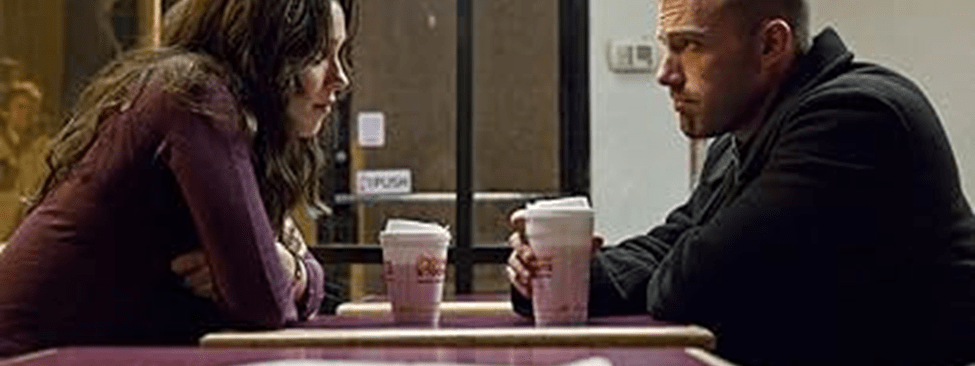
Although this may appear to be a date between Doug and Claire, it is not. It is Doug’s way of figuring out who Claire is and what she knows. Prior to this scene when he picks her up for the date, Claire indicates that the FBI has her on surveillance likely because the kidnappers know her face. Doug is surprised but then begins acting like his own version of an FBI surveillance team.
In the interrogation scene, Doug jokes about the FBI agents, Frawley and Dino, surveilling him and the crew, calling them a counter-surveillance team not much worthy of a six-year-old with the same or similar equipment. However, Doug is acting in very much the same way. He is countering the counter-surveillance by getting ahead of the FBI and finding out more than they know. He pursues Claire under the guise of dating and possibly seeking a romantic relationship.
Doug is “guiding” Claire again in the same way he guided her at the bank vault. He is guiding how she should conduct herself with the FBI. She doesn’t tell everything she remembers about the robbery, and Doug guides her by telling her that she holds all the cards. She doesn’t have to play them right now. She is in the metaphorical driver’s seat. Doug’s guidance keeps her from fully telling the FBI about James’s Fighting Irish neck tattoo she saw during the robbery. Of course, Doug is invested in the idea of not revealing James and him returning to prison. He is also invested in the idea of not getting caught and Claire recognizing his voice.
In fact, as much as Doug and Claire spend time together, she never recognizes his voice, his demeanor, or anything related to her encounter with Doug during the bank robbery. She doesn’t sense smell, tone, the rhythm in which he speaks, his mannerisms, and his very person in sitting down with him and having conversations and going out on dates.
Doug without the Skeletor mask distracts Claire from the Doug as a regular, every day, working individual who only a few people know is a bank robber too. Essentially, the evidence that Doug gathers is confirmation that Claire doesn’t recognize him.
Asking for Help to go against the Goal (surveillance)

Doug is invested more into helping Claire than supporting James and the family business.
Prior to this scene, Claire informs Doug that she was harassed by residents in the projects. She says her car was vandalized and that she must walk through the projects. Some residents harassed her by throwing bottles at her, so now she must walk around the projects to get home. Doug is bothered by this news and asks Claire what the men look like. Doug returns to the house James and he share as roommates and asks him to participate in a crime for which he can’t reveal the reason why.
James replies, “Which car are we taking?”
Both men travel to the projects. The narrative leaves out how they know who the person is, but the description that Claire provides to Doug is an indicator that he is certain about the person.
They hide their faces with hockey masks, which is ironic because Doug got kicked off a professional hockey team because of his on-court antics. They disguise their voices as someone the resident might know. They break in, beat up the two men in the apartment, and then attempt to leave. However, true to form, James gets hasty and greedy for the opportunity to do more than what was required in the situation, shoots the one guy in the leg twice, and then both men leave.
While James drives, Doug remarks about the situation:
“I can’t be killing people,” Doug says.
James replies about the situation:
“Yeah. Well, you brought me.”
In other words, Doug can’t have it both ways.
He is annoyed at James’s antics during the bank robbery and is annoyed at James’ idea of reciprocation. However, when it suits Doug to use James for a retaliatory situation, he is not annoyed. It is like James has a key at his back that Doug knows how to turn when he needs James to be an attack dog of sorts. Then when the deed is done, Doug sits back in judgment of James’s tactics.
Doug can’t have it both ways. He can’t need James when he wants and use James when he wants and cry when James does “James.” Either Doug wants out of the business, or he doesn’t. James is not his problem. Doug is his own problem. Using James, lying to James about his relationship with Claire, and threatening to leave James for Florida are just as triggering for James and his mental, emotional, and psychological issues as the bank robbery is triggering for Claire.
No, they are not the same events, but Doug is the common denominator. He triggers them both at will and pulls himself back to look at the carnage he creates without much contemplation. His only reserve is to “get out of this town” and not do much more than that. Doug can’t have it both ways.
Checking up on the Goal (surveillance)
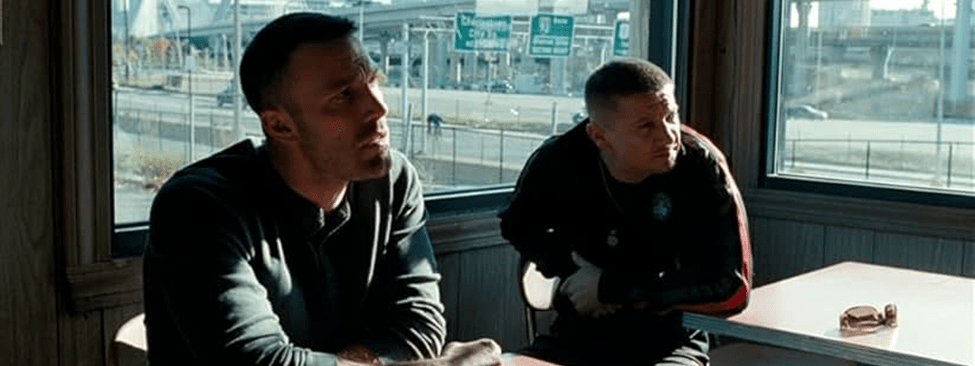
Although James is a hasty individual and character, he has more follow-through than Doug.
Yes, Doug checks up on that thing called Claire, but he ends up getting involved romantically with Claire. James keeps his emotional distance and looks at the situation that needs to be handled.
The fact that James is checking in with Doug on “that thing” suggests that Doug has been under surveillance from James. There is no narrative or film or dialogue proof of this, but James showing up and asking if Doug has handled the issue suggests that James has been watching Doug. This could be true and supported by Fergie’s revelation that he knows about a girl who Doug has been seeing. He threatens to send a funeral wreath to her house if Doug refuses to participate in the ballpark robbery.
Without Fergie and James having direct dialogue in the film about this notion, Fergie’s revelation suggests that he and James have been talking about Doug. When Doug and James have their fight at the gate about the next best thing, i.e., the ballpark robbery, it is James who tells Doug about the robbery, not Fergie telling Doug. In the battle of who is in charge, it seems that James takes his orders from Fergie, or what James knows could be interpreted as getting his instructions from Fergie.
James is in the game. He is in the family business. He is not leaving. James is not Doug’s father, Big Mac, who wanted to go his own way, but Fergie got in the way and got him back in line. No, James wants this life characterized as family business. In this scene, Doug does not reveal the inner workings of his strategies with Claire. He just says that she is no longer a threat, or at least he hints that she is no longer a threat, but he doesn’t say how he has handled the situation, leaving James’s mind to wander.
James doesn’t get the resolution for his goal in the moment. His initial goal was to handle Claire until Doug snatches the ID out of his hand. James’s goal is lingering, wandering, waiting, hoping, and incomplete. It isn’t until the next scene that James realizes Doug’s duplicity in accomplishing the goal.
Confirmation the Goal is not Complete (surveillance)

It is in this scene that James likely feels betrayed. In a previous scene, James asks Doug about handling the thing called Claire. Doug suggests that they don’t have anything to worry about, and the thing has been handled.
However, this scene reveals that Doug has been lying and that he is a liar. James doesn’t call him a liar, and the film doesn’t call him a liar, but this scene supports the notion of James being blindsided. He didn’t expect to see Claire, and he is reasonably shocked when she comes to sit down with Doug.
James knows who Claire is, but Claire doesn’t know who James is. She also doesn’t know that two of the four bank robbers are sitting before her, and she still doesn’t recognize their voices. Granted, both men were in costume and part of that costume disguised their voices. In addition, it is hard to pay attention to mannerisms when they are in costume.
For the most part, James was yelling, and he was behind Claire. When they took Claire hostage, she didn’t see their faces. Only the driver said something in the moment. Then Doug said, “Everything is going to be okay” or “You’re going to be alright. No one is going to hurt you.”
Doug was the closest to her in space and apart from the other men. Claire’s inability to recognize his voice more than the others is surprising, but it is not deliberate. She genuinely doesn’t know who the men are sitting before her.
When James questions Claire, even with knowing who she is, he is performing an intentional, inquisitive, and interested individual to a “stranger.” James may not know Claire personally and on a personal basis in his everyday life, but he knows who she is and now he must determine why she, the hostage, is sitting with Doug at a table eating pizza and on a sunny day.
Doug and Claire essentially look like a couple, and Doug looks like he is seemingly eating with Claire on her lunch break. The scene looks normal, and James comes into the scene to break up this normalcy. James, as a character, is a disruptor and interrupter. He is also prone to use prevention and intervention techniques. Claire doesn’t pose as the obvious threat for James. Sure, she is the former hostage who Doug is courting and who James finds out about in this scene.
No. Claire is a threat to James’s ideal of Doug and Kris being together. Without saying as much and without assuming as much, Claire works like the other woman to Doug and Kris. Kris wants Doug. James wants Doug and Kris to be together. However, Doug does not want Kris. He does not want the family business. He doesn’t want James’s ideal of all of them “working” side by side, robbing banks.
When James realizes the threat called Claire, he realizes that he must adjust his thinking about Doug, saying to Claire that Doug likes to take his work home with him. This is a problem because of the fear that Claire would turn them both over to the feds. In this scene, James receives confirmation that Doug has not handled the problem called Claire.
Afraid the Goal will be Revealed (surveillance)

Doug is afraid in his eyes. This scene technically precedes the previous one, but it is important to show the fear in Doug’s eyes after James’s interrogation. James is interrogating Doug just as much as the feds interrogate them after one of the bank robberies.
Ironically, James is the most levelheaded in this dynamic between Doug and Claire, Doug and James, and Doug and the rest of the crew who do not know that he is courting Claire. The family business is what matters, and Doug is compromised.
The problem with Doug being compromised is that he no longer cares. Somewhere in his mind, he knows he is leaving Charlestown. Whether James has a firm understanding of his decision is not his business. What Doug’s decision suggests is that all the money he has been getting from robbing banks and cash trucks he has been saving.
It is like a scene out of Sleeping with the Enemy where the audience learns that the “volunteering at the library” the female protagonist, Laura, has been doing was really a job for which she was earning money. She saved the money from that job and hid it in a getaway bag for when she had the opportunity to leave her abusive husband.
The relationship between Doug and James has some similarity even if they are not romantically involved. James acts like a jealous and psychologically abusive lover who is always watching Doug, and Doug acts like an abused, victimized, and traumatized lover who tries repeatedly to get away. The money he has at the end of the movie and shares with Claire by burying it in the garden, so she can find it, has the same sentiment of a victim running away from his victimizer.
However, as noted in a previous discussion, Doug can’t have it both ways. He is not a victim. Keeping the news about who he is from Claire and from James reveals his duplicity. He is playing both sides even if he may be motivated to run away with Claire for a better life. Doug is essentially afraid of James finding out who he really is, and that James should not have shot someone on his behalf. James shouldn’t have been so loyal to Doug is what Doug is truly afraid of in this scene.
Confrontation with the Goal in Mind (surveillance)

The fear that Doug has of finding out he is not interested in being loyal to the family business is confirmed in this scene. The two men confront each other, albeit ceremonially.
However, the discussion centers on the next thing, i.e., the ballpark robbery, for which Doug says to get someone else. Doug is not interested in participating and says, “I’m putting this whole town in my rearview mirror.” Doug further confirms, implicitly, whatever he has been doing up to this moment has centered on escape, exiting, leaving, moving on, getting out of this dangerous place, and starting a different family business without the robbery expectations.
Doug tells James that he can come visit him in Florida, which triggers James to attack Doug. They fight, tussle about, fall to the ground, and then continue their discussion. James fighting with Doug is about family loyalty to him and to Kris, but Doug repeatedly tells James that Kris’s baby is not his kid and that he doesn’t have loyalty to either one of them, albeit implicitly.
James is an interesting character in this scene. He acts like a father to both Doug and Kris, suggesting to him that Doug and Kris must marry (ceremoniously) and become a family, i.e., playing house. It is in his words to Doug that reveal James’s intention to keep the family together. This doesn’t mean that James wants to give up the family business of robbing banks and cash trucks. It just means that he wants all of them to be a unit.
In other words, James lives in the ideal. He romanticizes the family business, robbery, and the managed chaos. He acts seemingly like a “godfather” without the wealth and clout and influence. He reports to Fergie, The Florist, so there is a hierarchy that James is willing to maintain and support.
Whether James has ambitions is unclear. His only vision in life is not to return to prison even if he continues to commit criminal actions that will send him back. He did nine years for what he believes to be on behalf of Doug. He found out that someone was going to take Doug out, and James said, “I put him down.” Then he expects Doug’s reciprocation and compliance, telling him, “You’re not walking away.” James sensed Doug’s walking away process long before the presence of Claire.
Claire is not the true reason why Doug desires to walk away from James, Kris, the crew, and the family business. I believe Doug’s true reason for wanting to walk away has something to do with his father who is in prison for life and who he visits at least once in the film. Hearing the stories of Big Mac not snitching and doing the time has become folklore for new generations wanting to start their family businesses in robbery and criminal activities. If Doug wants to leave the family business, then he is not as convinced that the family business is the right place for him.
Even Big Mac wanted to leave and do his own thing, but Fergie said no. This suggests too that Big Mac didn’t think the life he had doing bank robberies for someone else was good enough for him to continue putting his life on the line. In Doug wanting to leave and trying to get out before he suffers the same consequence as his father in going to prison or even dying, he is suggesting that there is a better life than what he has been doing, and he wants to take Claire along with him. Thus, freedom, not Claire, is truly the threat for James, who sees freedom as robbery.
Select Topics
These are the select topics on this topic. They extend the discussion of goal development.
New Robbery Goal: Forced to Submit to Another Goal (return to stasis/purpose)

Doug’s decision to participate and contribute to the ballpark robbery is based on a threat that Fergie makes concerning Claire. The film reveals that Fergie knows about Claire and threatens her life. The backstory of how Doug’s mother’s absence is revealed in a previous scene as well.
These two facts motivate Doug to “come back” into the family business and support the crew. In other words, he has no other choice but to comply, and when anyone enters the life of criminal activity, the standard way out is by death or prison. Fergie does not directly threaten Doug’s life, as in ensuring he would die if he refused to participate, but he does suggest that in “clip your nuts” that it would be life-altering. Doug could end up like his father in prison.
The men in this scene may be mature in age, but they are emotionally immature. They are all looking for a father, and they want a father. Fergie becomes the father they need even if his role is false. It doesn’t matter. James is convinced that Fergie is necessary. Dez and Albert McGloan do not care either way. However, Doug knows for certain that Fergie is not his father because at the end of the film he “clips his nuts” by shooting and killing him. Doug killing Fergie confirms that he didn’t consider him a father or father figure.
Other than James handing the cut to Fergie at the beginning of the film, there is no conflict between James and Fergie. However, when Doug walks into the shop and says he wants out of the ballpark robbery, Fergie, implicitly, calls James “Joe Flipperhead,” saying, “You think I’m going to put Joe Flipperhead on it?” He suggests that Doug is the leader and that they are all a unit. There is no one without the other.
In all cases dealing with the robberies, the four men do work well together. Except for heated, hasty moments from James, they all manage to complete the robberies they started whether they were in the bank or cash truck. They are efficient, and their expertise builds with each robbery, no thanks to Fergie. However, they get their instructions and plans from Fergie, making them wholly dependent on him for guidance.
In other words, they are guided through the family business, life of robbery, and management of secrecy. Just as Doug guides Claire in opening the bank vault, guides her in not revealing the Fighting Irish neck tattoo on James’s neck, and guides her by pursuing a romantic relationship without revealing who he is, Fergie guides the men likely from teenage to young adulthood and now as adult men. The community expects the children of gangster fathers sent to prison to step into their father’s roles and take over their parts in the family business. The kids are not expected to pursue anything else.
This may or may not be true, but what is true is that Dez and Doug deviate somewhat from this expectation because they are the ones seen with jobs in the film. Dez works for Vericom, and Doug works for Boston Sand & Gravel. Albert doesn’t work; he appears in a montage or flashback as breaking into parked cars. When Doug asks James for help with the men who attack Claire in the projects, James is depicted as bored and watching television, nothing more.
His only activity is robbery. Beyond Fergie working in his own florist shop, his henchman working for him, Claire working at the bank, and the federal agents working, working is partly promoted. Dez’s job gives him access, and Doug works breaking rocks because he has to do it. There is no passion around the work.
Regardless, Fergie fills the absence of fatherhood, which he creates and perpetuates the absence by requiring their complete compliance with his whims. Fergie doesn’t need any of the men. He knows another group of men who have absentee fathers will step up and participate in the family business.
What Fergie needs essentially is continuity not the individual person because Fergie does not work. He makes other people work for him. He even says that the men make him feel like he is still in the trenches. However, he is not willing to take the risks that they take. Fergie is not a worker.
Family Conflict: When Your Father Continues the Goal to Keep You in the Dark

Doug’s relationship with his father is plagued with questions about his mother.
Doug asks his father why he never looked for his mother who went missing. We find out the reason why she went missing is because Big Mac wanted to leave Fergie and do his own thing. Fergie was offended at that idea and likely set him up to be caught, which further led to him entering prison. Fergie says he “put the hook in and she doped up proper.” Fergie drugged his mother, Doris, which led to her committing suicide. Fergie calls her a “suicide doper” and mocks Doug for putting up posters to find his mother.
Fergie says that his father didn’t have the heart to tell him about his mother. This happens later in the film, and this revelation about his mother and father motivates Doug to kill Fergie later. We do not see Doug’s planning surrounding this. We just get to the part where he kills Fergie.
When Doug asks his father, Big Mac, about his mother and why he didn’t look for her, he says, “There was nothing to find.” He speaks from a place of bitterness and strangely, a place from offense. For a person who believes in the family business and even wanted to start his own crew, he is offended as he leaves the waiting room. He is impatient with the doors opening and pushes them away as they do open. He leaves his son confused and hurt and emotionally distracted. What is noticeable about this scene is Big Mac’s anger. This begs the following questions:
- Why should he be angry with having to serve a life sentence in prison if he agreed with the family business?
- Why should James be afraid to return to prison if he agreed with the family business?
- Why should Doug be willing to leave it all behind if he participated in the family business?
These three men are walking contradictions because they are fine with committing the crime but lack understanding about the consequences. They do not think the consequences apply just because those consequences are predicated on criminal actions. One should have nothing to do with the other.
Doug sitting with the phone after the father leaves suggests that none of his questions were truly answered. All he saw and heard was a biological father unwilling to provide the closure he needed. Ironically, it takes Fergie to provide the answers Doug needs to get closure.
Yet, Doug kills the man who gives him closure, who clears up a misunderstanding about his mother, who serves as a pseudo-father, and who provides him with the skill and knowledge necessary to help him be successful in robbing banks. Fergie does more for Doug than all the other characters combined, and that is an irony that should not make sense, but it does.
Family Conflict: When the Pretend Father Creates Goals for You

Fergie, The Florist, is in no way an ethical, moral, and good character, but he is consistent in his management style. The men work for Fergie in robbing banks, which suggests self-serving, selfish behavior. However, Fergie does give them consistent “work” even if the work could lead them all to prison. Fergie works like a manager, facilitating the goal, “hiring” the right people to facilitate completion of the goal, and conducting a post-robbery process review of the completed goal. The men do respect Fergie as much as they can and with whatever emotional wherewithal they have for him.
The respect they show, however, is truly that of fear. Fergie does not reveal his connections and the extent of his influences. He has the equivalent of a hitman or bodyguard sitting in the shop with him who has an affinity for James but a suspicion for Doug. Both men know that Doug is not as loyal as they would like to believe. This does not mean that Doug has loyalty to himself. This just means that Doug has loyalty to the ideal of leaving Charlestown.
Just as James romanticizes robbing, Doug romanticizes leaving. Doug wants to exit, and in many ways, he tries to accomplish this goal. Doug’s goal, ultimately, is not continuing to rob banks and remain in the family business. Doug’s goal is in exit, leaving the family business, and abandoning the “family.” In going to prison, Doug’s father, Big Mac, abandoned him. Big Mac didn’t set out to abandon his son. It was by default. However, pursuing a life of crime and expecting it not to lead to death or prison is delusional thinking. At some point, Big Mac wanted his own thing, and that is likely to control the outcomes for himself and his family. This didn’t happen; his wife committed suicide, and he went to prison.
Doug wanted different life outcomes and was willing to take Claire along with him. Florida was the place, the target, to pursue a better life apart from the family business that ironically touched her life. As much as Doug wanted to run away from the family business, it was still on the inside of him because it held the secret to who he was, what he had done, and the impact he had made on Claire’s life. The more he looked at Claire, the more he would be looking at a mirror of his mistakes that he could not ignore as he got deeper into the relationship.
Eventually, Doug would have to tell Claire who he was and that he was the bank robber who caused her trauma. Because he wasn’t willing to do that, which left an open door for Agent Frawley to reveal the truth, this truth affected the sanctity of their relationship. Doug’s fantasy had some cracks in it because it no longer included Claire.
Family Conflict: When the Goal is to Get Rid of the Pseudo Father (resolution)

The fake father must be removed. For all his great intentions towards Doug, especially given the fact that he was responsible for his mother’s death and his father going to prison, Doug has no other choice but to eliminate the threat. Doug knew that Fergie would be a threat that affected his peace in Florida. James already knew that Doug was going to Florida because Doug told him.
Claire knew he was going to Florida because Doug told her. If he had been successful in reaching Florida with Claire accompanying him, he ran the risk of dealing with unknown threats and ones that he could not control. Thinking about Claire, he was likely thinking about his mother and the same thing that Fergie did to her. Doug had to put Fergie down in the same way that James put down the man who was going to shoot Doug.
We do not get a backstory on that man, nor do we get one on Fergie. It is hard to justify Doug’s actions other than what Fergie reveals. We understand Doug is mad and angry at his life, self-sabotaging two opportunities to play professional hockey. He could have left Charlestown a long time ago, but he pursued chaos and conflict that affected his ability to sustain those opportunities.
Doug would rather have chaos than peace, but in shooting Fergie, he was tying up loose ends. Doug resolves whatever inner turmoil he has with that one shot, coming face to face with someone who pushes the family business but was willing to tear up a family to do it.
When Doug shoots Fergie, he shoots a generation of thinking surrounding robbery, the family business, and the criminal lifestyle. He shoots the idealistic thinking of robbing someone or some bank or some cash truck to make one’s life better. He shoots the problem and the solution provider. He shoots the pseudo-caregiver. He shoots the financial covering. He shoots the continuity. He shoots the name, the ego, the influence, and the net that he got caught in.
Ultimately, in shooting Fergie, Doug shoots himself. He shoots his history.
Conclusion
These are the concluding ideas for this case study.
Conclusion: Goal Completion

Doug accomplishes his goal to leave Charlestown.
This does not mean he is free or feels a sense of freedom. Freedom is a mental change and a different way of thinking. Robbing was a solution to a problem. It didn’t make it right. It just meant that it served the purpose Doug needed to get through a tough time in his life.
Doug’s tough time was experiencing two failures dealing with self-sabotaging himself as a potential pro-hockey professional. In addition, growing up without his father forced him to bear the burden of someone’s failure. Feeling obligated to James because he spent nine years in prison on behalf of Doug also created feelings of Doug being caged.
James kills someone to protect the life of Doug, but Doug says, “I didn’t ask you to do that” as if he believes James had a choice. Although true, James’s loyalty to Doug suggests that he believed he didn’t have a choice and managed himself accordingly.
Doug seems ungrateful, but he may also be indifferent to the nature of the lifestyle that his father exposed him to, and Fergie expected him to step in his father’s footsteps. It is arguable that Doug might have self-sabotaged his opportunities at professional hockey out of some unconscious decision to fulfill his father’s obligation to Fergie. If his father couldn’t be here, then Doug would take up the metaphorical mantle. He would take the baton and run his father’s race for him.
However, in setting the goal to leave Charlestown even when confronted by different characters who had a problem with this goal, Doug was intimating that there is life outside of the four walls of a neighborhood burdened and riddled with crime and chaos. Living in Charlestown was like living in a prison even though Doug never went to prison. It is reminiscent of an open-air prison.
Doug was spared.
In some ways, I believe the characters are jealous of this fact. Doug was spared what many of them had to go through because of their decision-making. Doug never went to prison. His father did. James did. Doug doesn’t understand the life these men were trying to keep him from, yet he is not as grateful as they believe he should be.
The question Doug asks his father during a prison visit about his mother frustrates his father. It has the sentiment of “Why are you asking me about something that no longer matters? I saved you from coming here. That’s all you want to talk about?” The father is frustrated with a son he doesn’t really know given that he went to prison when Doug was young.
However, Doug is a son who is stuck at an age when his father went to prison. He is forced to grow up in a different environment and without a mother who he believes abandoned him when he was six. Doug is just as frustrated as his father, and he needs a release from the emotional and psychological cage the people in his life have put him in. Whatever they believe Doug needs is contrasted with what Doug believes he needs.
Doug doesn’t just want to feel spared or be perceived as someone who was spared. Doug wants out. He wants to take those feelings of being spared and move into a frame of mind that provides other options.
When he realizes that Claire is a better option for him, despite his contribution to her trauma, he pursues her. He pursues what she represents. She represents a breath of fresh air, and he is willing to use her as oxygen on his journey out of Charlestown. He is hopeful that she will come with him at the end of the movie, but he proves in the end that he was willing to leave her behind for the opportunity to breathe outside of the cage of the town.
Doug leaves.
Copyright (C) 2025 Regina Y. Favors, Favors Film Guides, Favors Film Guides Online. All Rights Reserved.
 Favors Film Analysis